[New post] Diving into the past: the black divers searching for slave shipwrecks
Staff posted: " As he slipped through the kelp forest to the bottom of the Atlantic Ocean, Kamau Sadiki's eyes hooked onto something resembling the item he and fellow divers had been searching for. However, the water temperature was low at the site just off the coas"
As he slipped through the kelp forest to the bottom of the Atlantic Ocean, Kamau Sadiki's eyes hooked onto something resembling the item he and fellow divers had been searching for.
However, the water temperature was low at the site just off the coast of Cape Town, and visibility was poor.
Veteran diver Sadiki recalls the surge pulling him back and forth as he attempted to get closer to his "first visual of some tangible artifact" of the ship he'd heard so much about.
"It was a piece of wood material that was lodged into the rocks," he tells CNN Travel. "I hesitated before approaching it, and then the surge just carried me straight into it."
Sadiki became overcome with emotion when he grabbed hold of part of the wreckage of the Sao Jose-Paquete de Africa wreck, which sank off Cape Town while transporting over 500 enslaved Africans from Mozambique to Brazil in 1794.
It's thought that 212 of the captives, along with the crew, drowned in the incident.
"It was like I could hear the voices," says Sadiki, who was part of the dive team who located the wreck in 2015. "The screaming, the suffering, the terror, the pain and agony of all those individuals being shackled arm and leg, and then perishing in a wrecking event.
"I knew then that I wanted to help tell their story and get those silent voices into the history books."
Buried history
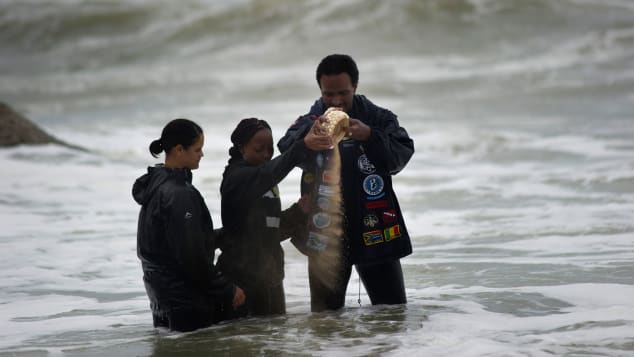
Divers scatter sand from Mozambique near the site where the wreckage of the Sao Jose-Paquete de Africa was found. Rodger Bosch/AFP/Getty Images
According to the Trans-Atlantic Slave Trade Database, around 35,000 ships were used to bring over 12 million enslaved Africans across the Atlantic between the 15th and 19th centuries. Some wouldn't survive the journey, and an estimated 500 to 1,000 of the ships, including the Sao Jos-Paquete de Africa, wrecked before reaching their destination. However, only five have been found in the many years since then, and just two have been adequately documented.
This ultimately means that the remains, along with the stories, of many of the captives who perished lie buried at the bottom of the sea.
Sadiki, lead diving instructor for Diving With a Purpose (DWP), a non-profit organization focused on the protection, documentation and interpretation of African slave trade shipwrecks, is among those attempting to bring this painful history to the surface.
DWP was founded in 2003 by Ken Stewart, a member of the National Association of Black Scuba Divers (NABS), and Brenda Lanzendorf, a maritime archeologist for Biscayne National Park, after both participated in the 2004 documentary, "The Guerrero Project."
The film told the story of the Spanish pirate ship believed to have crashed while carrying 561 kidnapped Africans in the Biscayne National Park off the coast of Florida.
After wrapping up the project, Stewart says he contacted all the divers who appeared on screen and said, "Tired of the same old dives, let's dive with a purpose."
He then teamed up with Lanzendorf, a park archaeologist at Biscayne, where a vast number of slave ships, along with the Guerrero, had wrecked. Stewart pledged to help her locate some of the wrecks along the area and teach other Black divers maritime archaeology techniques, while Lanzendorf promised to provide him with a vital piece of information in return.
"She said if we learned properly she'd show us where the Guerrero was," explains Stewart.




No comments:
Post a Comment